 July 13, 2026
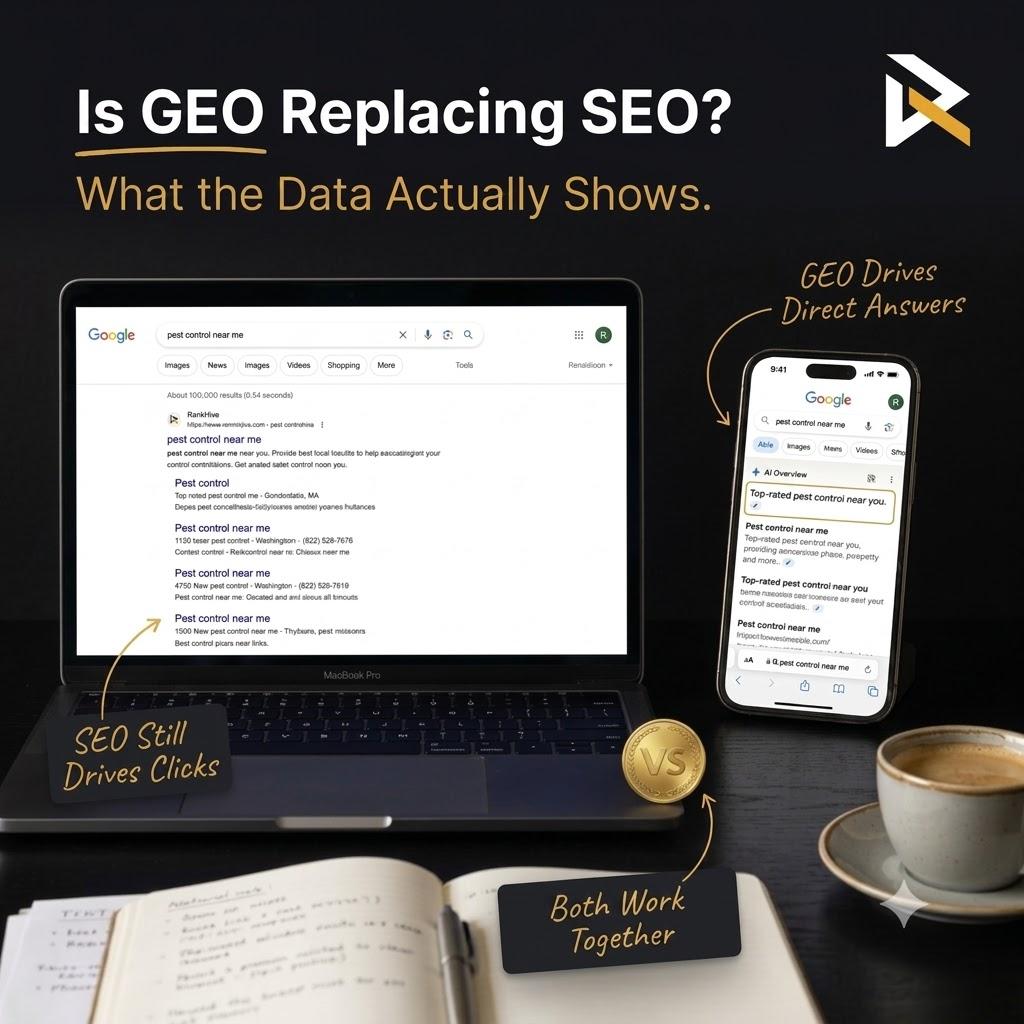
Is GEO Replacing SEO? What the Data Actually Shows
GEO is not replacing SEO. The debate around GEO vs SEO comes from a real shift in how people search, but the two work side by side rather than one pushing the other out, and the data backing this up is clearer than most headlines suggest.
Search behavior has genuinely changed. More people are asking ChatGPT, Perplexity, and Google's AI Overviews for direct answers instead of scrolling through ten blue links. That shift is real, and it deserves attention. But real change does not always mean replacement, and this article breaks down exactly what the numbers show, where the confusion comes from, and what it actually means for a business trying to stay visible in 2026.
What Is the Difference Between SEO and GEO
Search Engine Optimization is the practice of ranking your website higher on Google and other traditional search engines. It relies on keywords, backlinks, site speed, and technical structure to earn a spot on the results page.
Generative Engine Optimization is newer. It focuses on getting your content cited, quoted, or referenced inside AI generated answers from tools like ChatGPT, Perplexity, and Google's AI Overviews. Instead of earning a click, GEO earns a mention inside the answer itself.
The geo vs traditional seo key differences come down to three things.
- SEO aims for a click. GEO often succeeds without one.
- SEO ranks pages using deterministic algorithms. GEO relies on language models generating unique responses each time.
- SEO has decades of established metrics. GEO measurement is still developing.
Understanding what is the difference between seo and geo matters less as an academic exercise and more as a practical starting point for deciding where to invest your time. These differences are the foundation of every GEO vs SEO comparison you'll come across.
What the Actual Data Shows About Search Behavior
Multiple industry reports point to a genuine rise in AI assisted search, particularly among younger users researching products and services before making a decision. AI Overviews now appear on a large share of Google searches, and tools like ChatGPT and Perplexity have grown from experimental novelties into daily habits for millions of people.
At the same time, Google still processes billions of searches every single day. That number has not collapsed. What has changed is the type of query most affected by AI answers. This is exactly the kind of nuance that gets lost in most GEO vs SEO debates.
- Informational queries, meaning questions with a single clear answer, are the ones most likely to get resolved directly inside an AI response without a click
- Transactional queries, meaning searches where someone is ready to buy, book, or compare specific options, still drive people to actual websites far more often
This distinction matters enormously, and it is the piece most missing from the current conversation around GEO vs SEO.
Why the "SEO Is Dead" Narrative Gets It Wrong
This pattern repeats constantly in every GEO vs SEO discussion. Every few years, a new technology sparks predictions that SEO is finished.
- Voice search was supposed to kill it
- Mobile search was supposed to kill it
- Featured snippets were supposed to kill it
None of them did, and the pattern with GEO looks similar so far.
Here is the fact that gets buried in the hype. Google's own AI Overviews pull heavily from pages that already rank well organically. If your site has weak SEO, you are far less likely to get cited by the very AI tools everyone assumes are replacing SEO altogether. In other words, strong SEO is often the foundation that makes GEO possible in the first place.
That relationship alone should end most of the replacement debate on its own.
GEO vs SEO vs AEO: Clearing Up the Confusion
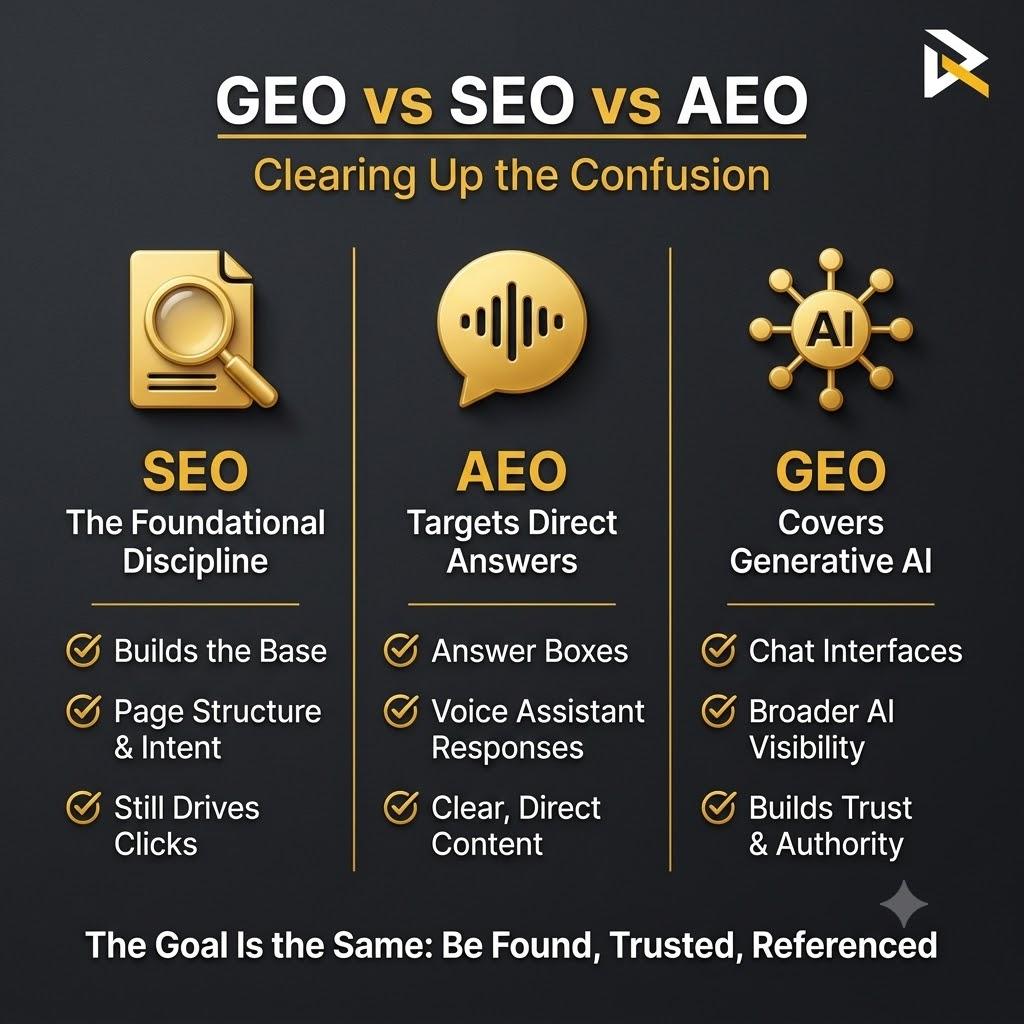
Part of why this topic feels so murky is the number of overlapping acronyms floating around. Seo vs geo vs aeo gets used almost interchangeably in casual conversation, but there are subtle distinctions worth understanding.
- Answer Engine Optimization, or AEO, specifically targets getting your content pulled into direct answer boxes and voice assistant responses
- GEO is broader, covering visibility across generative AI tools generally, including conversational chat interfaces
- SEO remains the foundational discipline both newer terms build on
In practice, most businesses do not need to obsess over which exact label applies. The underlying goal across all three is the same: be the source that gets found, trusted, and referenced, regardless of which interface someone used to ask the question.
Do I Need Both SEO and GEO for My Website
For almost every business, the honest answer is yes. Do i need both seo and geo for my website is one of the most common questions business owners ask once they start hearing about this shift, and the answer depends less on preference and more on where your customers actually search.
- If your customers still primarily click through search results to compare options, read reviews, or browse a catalog, SEO remains your primary channel
- If your customers increasingly ask AI tools open ended questions before ever visiting a website, GEO deserves real attention too
Most businesses fall somewhere in the middle, which is exactly why the GEO vs SEO debate creates unnecessary risk when treated as an either or decision.
Which Is More Important, SEO or GEO, for Businesses
This question sits at the center of nearly every GEO vs SEO conversation happening right now. Which is more important seo or geo for businesses genuinely depends on your industry, your audience, and your sales cycle. A local service business booking appointments still relies heavily on traditional search and map results. A software company selling to research heavy buyers may see meaningful traffic influence from AI recommendations earlier in the funnel.
Here is a simple way to think about prioritization based on business type.
| Business Type | Primary Focus | Secondary Focus |
|---|---|---|
| Local service business | SEO and local search | Light GEO for informational content |
| Ecommerce retailer | SEO for product and category pages | GEO for comparison and buying guide content |
| B2B software company | Balanced investment in both | Strong GEO for top of funnel research queries |
| Content publisher | SEO for traffic and ad revenue | GEO for brand authority and citations |
This is not a rigid rulebook. It is a starting point for deciding where your limited time and budget should go first.
How AI Tools Actually Decide What to Cite
Understanding why some content gets pulled into an AI answer and other content gets ignored helps explain a lot of the confusion around GEO vs SEO.
Most generative AI tools rely on a mix of training data and live retrieval, meaning they pull relevant web content at the moment someone asks a question, then generate a response using that material as context. This process favors certain kinds of content over others.
- Clear, direct answers positioned near the top of a page, rather than buried under a long introduction
- Content that states facts plainly instead of hedging with vague language
- Pages that are already indexed, technically healthy, and easy for a crawler to parse
- Original information, data, or perspective that cannot be found word for word on ten other sites
None of these factors are exotic or mysterious. They mostly describe what good content has always looked like, which is part of why the line between strong SEO and strong GEO keeps blurring the more you look at it.
SEO vs GEO Timelines
Timeline confusion is one of the most common sticking points in any GEO vs SEO comparison. Timeline expectations differ significantly between SEO and GEO, and setting the wrong expectation is one of the fastest ways to abandon a strategy too early.
- Traditional SEO has a well documented pattern. Meaningful ranking movement typically takes a few months, with stronger organic traffic building over six months to a year, depending on competition
- This timeline is backed by years of consistent data across countless industries
- GEO does not yet have that same maturity, since early evidence suggests visibility inside AI answers can shift faster in some cases, but there is far less historical data to predict a reliable timeline
- A business might see a mention appear within weeks, only to disappear the next time the same question is asked, since AI generated answers are not static rankings the way search results are
This unpredictability is not a flaw to panic over. It simply means GEO should be treated as a longer term brand visibility effort rather than a channel you can forecast with the same confidence as traditional SEO.
Adjusting Your Content Strategy
Content built to genuinely help a real person, answer their question clearly, and back up its claims with credible information tends to perform well across both traditional search and AI generated answers.
- The businesses struggling most with this shift are usually the ones that were already publishing thin, generic content that never deserved to rank well in the first place
- The more sustainable approach is folding GEO best practices directly into how you already write and structure content, rather than treating it as a separate strategy bolted on afterward
- Clear headings, direct answers, credible sourcing, and regular updates were always good practices, they simply matter for a wider set of platforms now than they did a few years ago
When GEO Investment Pays Off Fastest
GEO tends to deliver the clearest early wins in a few specific situations. Businesses selling complex products that people research extensively before buying often benefit early, since AI tools are frequently used during that research phase.
Companies producing original data, expert commentary, or genuinely unique insights also see faster GEO traction, since AI systems favor citable, authoritative sources over generic recycled content.
On the other hand, highly transactional searches, such as someone searching a specific product name ready to purchase immediately, still overwhelmingly favor traditional search results and paid listings over AI generated summaries. Recognizing these situations early makes the GEO vs SEO decision far easier for a specific business.
Common Mistakes Businesses Make Chasing GEO
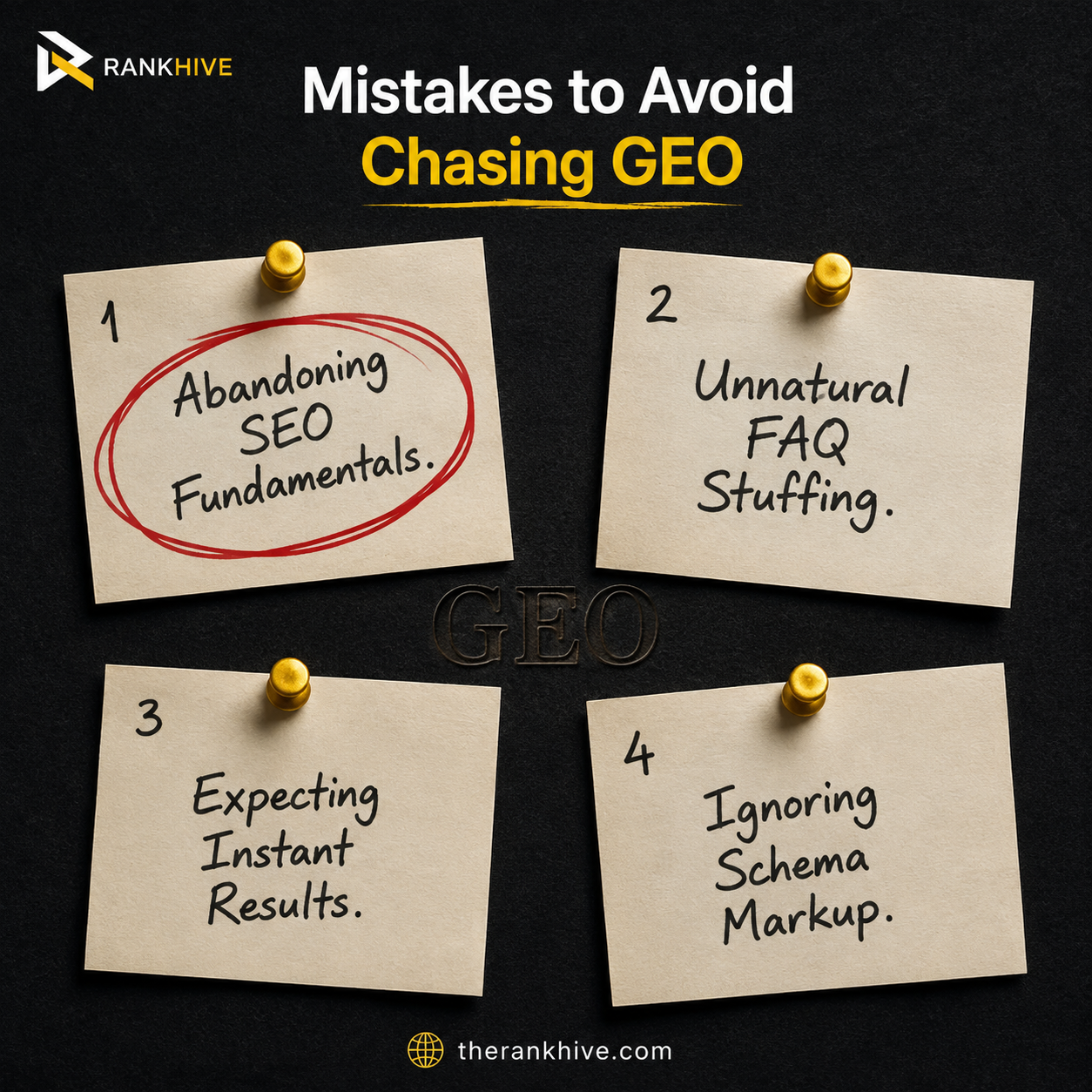
Most GEO vs SEO mistakes come down to overcorrection in one direction or the other. A rush toward anything new tends to produce sloppy execution, and GEO is no exception. Watch for these patterns.
- Abandoning solid SEO fundamentals to chase AI visibility, which usually backfires since strong SEO often feeds GEO success
- Stuffing FAQ sections with awkward, unnatural phrasing purely to match assumed AI query patterns
- Expecting fast, easily measurable results when GEO attribution tools are still genuinely immature
- Ignoring schema markup, which quietly helps both traditional rankings and AI extraction at the same time
Avoiding these mistakes matters more than chasing every new GEO tactic that appears in a LinkedIn post.
How to Start Balancing Both Without Overhauling Everything
You do not need to rebuild your entire content strategy overnight. A practical starting approach looks like this.
- Audit how AI tools currently represent your brand by asking them questions your customers would ask
- Keep your strongest existing SEO content updated and technically healthy, since this remains the foundation both disciplines rely on
- Add clear, direct answers near the top of key pages, formatted in a way that is easy for both humans and AI systems to extract
- Track traditional SEO metrics as you always have, and separately monitor AI mentions manually until better tooling matures
This kind of steady, layered approach avoids the trap of overcorrecting toward GEO at the expense of the search traffic that still drives most business results today.
Finding the Right Partner for This Shift
Choosing the right partner is often the hardest part of navigating GEO vs SEO in practice. Plenty of agencies now market generative engine optimization services, but the space is new enough that expertise varies wildly. A seo services agency in usa that genuinely understands this shift should be able to show real examples of content appearing inside AI answers, not just a general promise that it is happening.
For small businesses specifically, seo and geo services for small businesses should be realistic about budget and timeline rather than overselling fast results in a discipline that is still maturing. The same caution applies to any small business geo services provider or company for geo services claiming guaranteed AI citations, since no legitimate agency can promise placement inside a model's generated response the way they might promise a ranking strategy.
Frequently Asked Questions
Is GEO replacing SEO?
No, GEO is not replacing SEO. AI tools rely heavily on well ranked organic content, so strong SEO remains the foundation that GEO builds on.
What is GEO in digital marketing?
GEO stands for Generative Engine Optimization, the practice of structuring content so AI tools like ChatGPT and Google AI Overviews cite or reference it directly. It focuses on clarity, authority, and direct answers rather than traditional keyword ranking alone.
What are the 4 types of SEO?
The four main types of SEO are on page SEO, technical SEO, off page SEO, and local SEO. Each addresses a different part of how search engines evaluate and rank a website.
Is SEO being phased out?
No, SEO is not being phased out, since billions of searches still happen on Google every day. What is changing is the need to also optimize for AI generated answers alongside traditional rankings.
What is GEO vs SEO?
SEO focuses on ranking your website in traditional search results, while GEO focuses on getting your content cited inside AI generated answers. Both aim to build visibility, just through different mechanisms and platforms.
Is SEO dead or evolving in 2026?
SEO is evolving, not dying, as search now spans both traditional results and AI generated answers. Businesses that maintain strong SEO fundamentals are also better positioned for GEO success.
Want a content strategy that actually earns citations in AI answers, not just clicks? Talk to The RankHive about your next move.
Recent Posts
 September 09, 2026
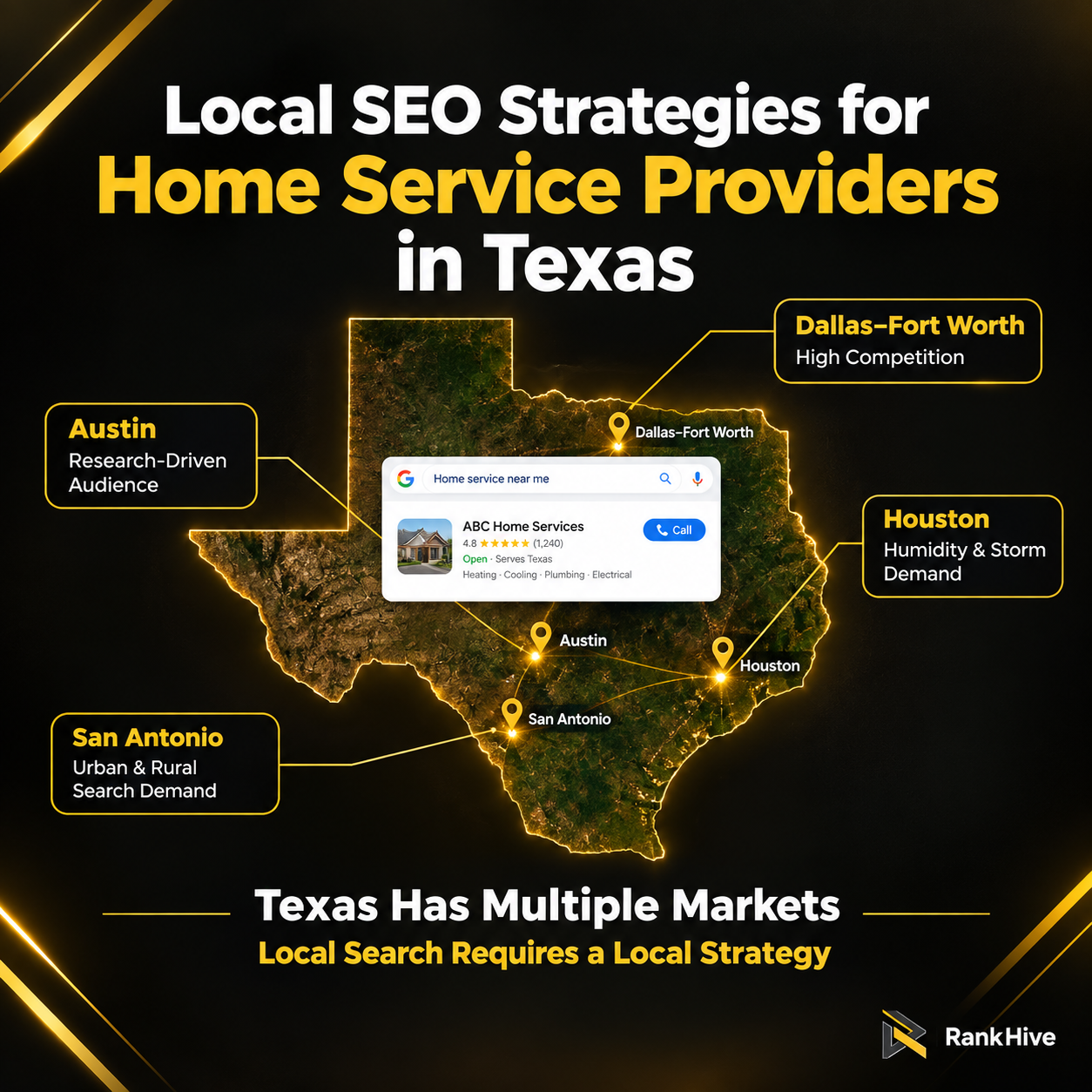
Local SEO Strategies for Home Service Providers in Texas
Local SEO strategies for home service providers in Texas help HVAC, plumbing, and roofing companies rank higher, appear on Maps, and win more local calls.
Read More
 September 07, 2026
Home Service Franchise Local SEO for North Carolina
Home service franchise local SEO helps North Carolina multi-location brands rank higher, dominate Google Maps, and turn nearby searches into real calls.
Read More September 05, 2026
Home Services SEO in Ohio That Turns Searches Into Calls
Home services SEO helps Ohio HVAC, plumbing, roofing, and cleaning companies rank higher on Google, show up on Maps, and win more local calls year-round.
Read More September 02, 2026
Local SEO for Home Services in Georgia That Actually Ranks
Local SEO for home services helps Georgia HVAC, plumbing, roofing, and electrical companies rank higher, get found nearby, and win more calls this season.
Read More